
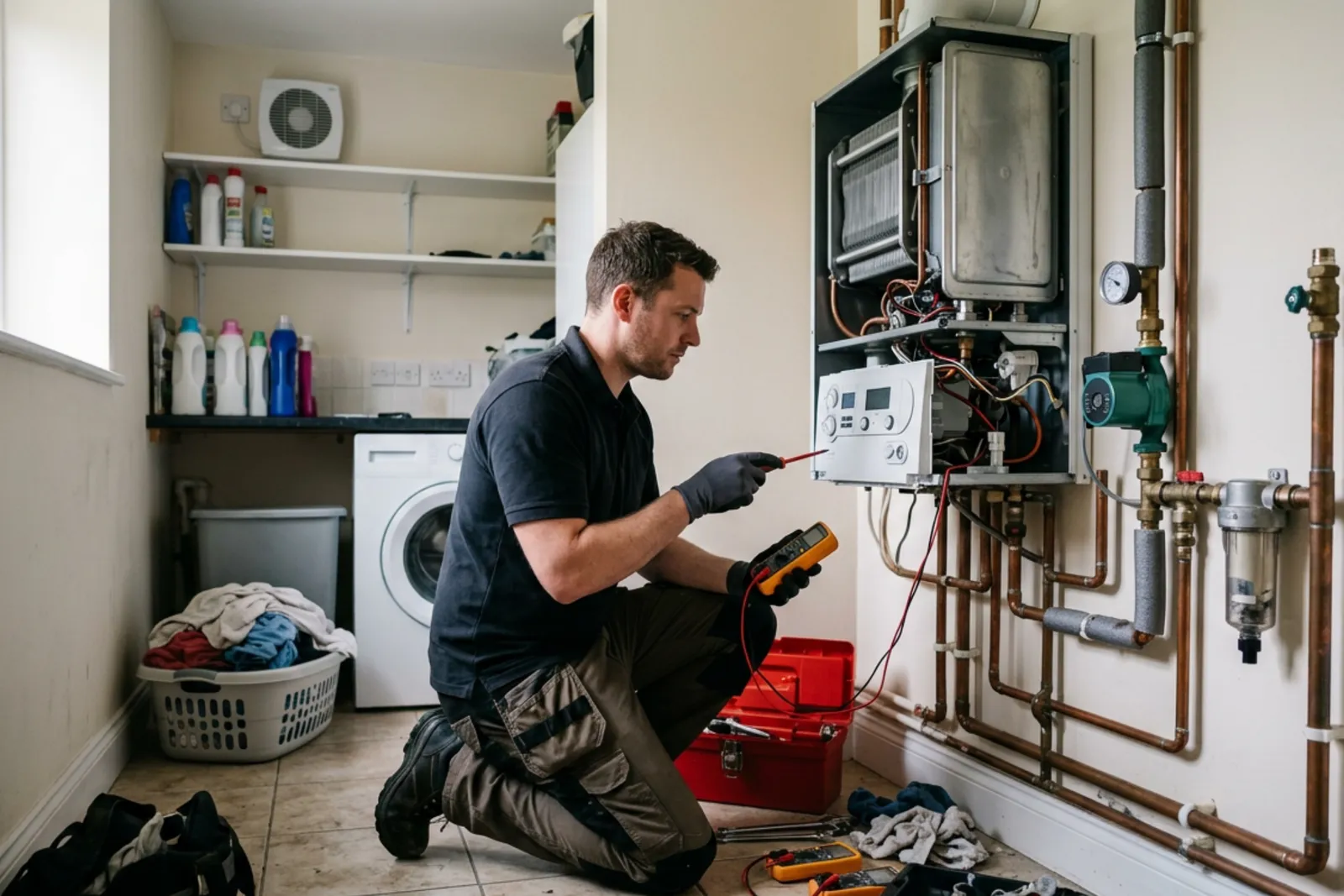
Planning a Hydronic Boiler Upgrade in West Vancouver
Planning a hydronic boiler upgrade in West Vancouver? Learn how sizing, system design, written scopes, and commissioning support reliable heat. Read the guide.
October 26, 2026
A boiler replacement can look straightforward: remove the old appliance, install a new one, and reconnect the pipes. In practice, the boiler is only one part of a heating system. Its performance depends on the home’s heat demand, the radiators or in-floor heating it supplies, the controls, and the way water moves through the piping.
For homeowners in West Vancouver and across the North Shore, a successful upgrade starts well before installation day. It requires a clear assessment, suitable equipment, a written scope, and careful testing after the work is complete.
Modern condensing boilers can reduce heating energy use compared with older equipment. They can also improve temperature control. But a high efficiency rating alone does not guarantee either result. The system needs to let the boiler operate efficiently, and commissioning needs to confirm that it works as intended.
Start With the Home, Not the Old Boiler
The capacity printed on an existing boiler is useful background information, but it should not be the sole basis for selecting its replacement. Older boilers are often oversized. The home may also have changed since the original installation, with better windows, added insulation, or an expanded living area.
A heat-loss calculation estimates how much heat the building needs under local winter design conditions. It considers factors such as floor area, insulation, windows, air leakage, and exposure. Room-by-room calculations help determine whether each space has enough heating capacity.
This matters because a boiler that is too large can cycle on and off frequently, particularly during mild weather. Short cycling can increase wear and reduce seasonal efficiency. A boiler that is too small may struggle to maintain indoor temperatures during colder conditions.
Many modern boilers can modulate, meaning they adjust their output rather than running at one fixed rate. Even so, their minimum output matters. A small heating zone may need less heat than the boiler can produce at its lowest setting.
The assessment should therefore consider both the home’s maximum demand and the smaller loads it will experience during everyday operation.
Understand What a Condensing Boiler Needs to Work Well
A condensing boiler captures heat that would otherwise leave through the exhaust. When the water vapor in the combustion gases condenses, it releases additional heat that the boiler transfers into the heating water.
Some models have published efficiency ratings of 95% or higher under standardized test conditions. Actual performance depends on installation, operating temperatures, controls, and maintenance.
Return-water temperature makes a difference
For a natural gas boiler, condensation generally begins when return water is below roughly 130°F, or 54°C, although the exact threshold varies with combustion conditions. Lower return temperatures usually allow more heat recovery.
That is why the distribution system deserves attention. Radiant floors often operate at lower water temperatures and can pair well with condensing equipment. Older radiator heating systems may need higher temperatures during cold weather, especially if the radiators are small relative to the rooms’ heat losses.
That does not automatically rule out a condensing boiler. A system may need high temperatures only on the coldest days. At other times, lower water temperatures may provide enough heat.
Controls help match output to the weather
Outdoor reset control adjusts the target heating-water temperature as outdoor conditions change. During mild weather, the boiler sends cooler water through the system. As it gets colder outside, the target temperature rises.
The reset curve needs to suit the building. Set it too high and the boiler may spend less time condensing. Set it too low and some rooms may not stay warm. Fine-tuning is part of getting the installation right.
Assess the Entire Hydronic System
An older heating system may have serviceable radiators and piping but outdated pumps, unreliable valves, or controls that no longer suit the household. Replacing everything is not always necessary. Assuming everything can remain untouched is equally risky.
An assessment should examine the boiler alongside the distribution system, including circulators, expansion tank, air removal, pressure relief equipment, zone controls, and accessible piping.
Radiators and in-floor heating have different requirements
Radiators release heat according to their size, design, and the temperature of the water passing through them. In-floor heating performance also depends on tubing layout, floor construction, and floor coverings.
A home with both types may need separate temperature circuits. A mixing arrangement can supply lower-temperature water to the floor while another circuit serves radiators at a higher temperature.
Existing radiant tubing also deserves attention. Some older tubing lacks an oxygen barrier, which can allow oxygen into the system and contribute to corrosion of ferrous components. Depending on the materials and system condition, separation through a heat exchanger or another protective design may be appropriate.
Domestic hot water needs its own assessment
If the boiler also heats an indirect domestic hot water tank, that load belongs in the design discussion. The installer should explain how hot water demand affects boiler selection and control priorities.
A tankless water heater designed for domestic use is not automatically a suitable substitute for a space-heating boiler. Any proposed combination must be approved for the intended application and designed accordingly.
Pool heating and hot tub heating also introduce different operating conditions. Where these loads are connected, the design must account for water chemistry, heat exchanger separation, and control requirements.
Get a Written Scope Before Work Begins
A useful proposal explains what will be installed, what will remain, and what conditions could require additional work. A model number and a total price are not enough to describe a hydronic upgrade.
The written scope should address:
The boiler model, heating capacity, and basis for sizing.
Pumps, valves, expansion equipment, controls, and any piping changes.
Venting, combustion air, condensate disposal, and gas-supply work.
Required permits, inspections, and responsibility for arranging them.
System cleaning, pressure testing, balancing, commissioning, and homeowner handover.
Exclusions, repair allowances, and the process for approving changes.
For a retrofit, access can affect the work substantially. A new vent route might pass through finished areas. Existing piping may need alteration to fit the new equipment. A suitable condensate drain may not be nearby.
These are better discussed before installation than discovered after the old boiler has been disconnected.
Manufacturer selection should follow the system requirements. Output range, venting limits, service access, control compatibility, parts availability, and local technical support all matter. Brand familiarity alone is a weak selection method.
Address Permits, Gas Supply, Venting, and Condensate
Boiler installation can involve gas fitting, plumbing, electrical work, and building requirements. In British Columbia, applicable permits and inspections should be confirmed with the authority having jurisdiction. Depending on the location and work, that may involve Technical Safety BC, a municipality, or more than one authority.
Gas work should be completed by appropriately licensed contractors and qualified gas fitters. Ask who is responsible for each permit and inspection rather than assuming everything is included.
The existing gas line also needs verification. Its suitability depends on the total connected appliance load, pipe sizing, length, available pressure, and applicable requirements. An existing connection is not proof that the supply is adequate for new equipment.
Venting requires similar care. A condensing boiler may need a different vent system than the appliance it replaces. Approved materials, equivalent vent length, clearances, and termination locations must follow the manufacturer’s instructions and applicable rules.
Condensing boilers also produce acidic condensate. It needs a suitable disposal route, protection against freezing where relevant, and neutralization when required. Poorly planned drainage can cause leaks or shutdowns even when the boiler itself is operating correctly.
Balance Water Flow Before Judging Comfort
A new boiler cannot correct every distribution problem by producing hotter water.
Hydronic balancing adjusts flow so that heating circuits receive appropriate amounts of water. Without it, a short or low-resistance circuit may receive too much flow while another receives too little.
The result can feel familiar: one bedroom overheats while another stays cool, or a distant radiator takes far longer to warm up.
Balancing may involve valve adjustments, pump settings, manifold flow settings, or changes to the piping arrangement. Air trapped in the system can also interfere with circulation and create noise.
Consider a home with a main-floor radiant zone and upstairs radiators. If the circuits have different flow and temperature needs, simply connecting both to the new boiler may leave comfort uneven. The solution is to address those differences in the design and verify operation afterward.
Raising the boiler temperature might hide the problem temporarily. It can also reduce condensing efficiency.
What Proper Boiler Commissioning Should Include
Commissioning is the process of checking, measuring, and documenting how the installed system operates. It is more than switching the boiler on and confirming that the pipes get warm.
Pressure testing is one part of this work. It checks for leaks under an appropriate test procedure. Gas piping and hydronic piping require different methods, and testing must respect equipment limitations and applicable requirements.
A thorough commissioning process generally includes the following checks:
Confirm that the installation matches the design, manufacturer instructions, and applicable requirements.
Verify system filling, air removal, operating pressure, and expansion-tank setup.
Check gas supply and combustion with suitable instruments, making any adjustments permitted by the manufacturer.
Test pumps, zone valves, thermostats, domestic hot water controls, and relevant safety functions.
Record operating temperatures, control settings, and other required measurements.
Check system response across available zones and explain operation to the homeowner.
Water quality should be addressed too. Existing systems may contain debris or corrosion products that can damage a new heat exchanger. Cleaning methods, treatment chemicals, and fill-water quality need to meet the boiler manufacturer’s requirements.
Some checks are limited by outdoor conditions. A system commissioned in mild weather cannot demonstrate its full cold-weather performance. In that situation, the installer should explain which settings may need review once heating demand increases.
Ask for a commissioning record. It gives future service technicians a useful baseline and provides evidence that startup involved measured checks.
Set Realistic Expectations for Savings and Service Life
A high efficiency boiler can reduce fuel consumption, but a precise savings estimate requires more than comparing appliance ratings. Weather, thermostat settings, domestic hot water use, building improvements, and the condition of the old system all affect the result.
For example, replacing an inefficient boiler may reduce gas use, while heating a previously underheated addition increases it. The home can become more comfortable without the bill dropping as much as expected.
Likewise, a potential service life of 20 to 25 years is not a guarantee. Some boilers last that long with suitable installation, water quality, and maintenance. Others need replacement sooner.
Follow the manufacturer’s maintenance schedule. Regular professional service commonly includes inspection of the heat exchanger, burner, condensate path, venting, safety components, and combustion performance. The required tasks vary by model.
Between visits, homeowners can watch for pressure changes, recurring fault codes, unusual noises, leaks, or rooms that stop heating normally. Repeatedly resetting a fault or topping up system water can hide a problem that needs repair.
Finish With a Clear Handover
Before the job is considered complete, ask the installer to explain the controls, normal pressure range, shutdown procedure, and maintenance requirements. Keep the equipment manuals, permit records, commissioning results, and warranty information together.
You should also know which settings are intended for homeowner use and which should be left to a qualified technician.
A well-planned boiler replacement treats the appliance and the heating system as one connected project. Correct sizing establishes the starting point. Suitable piping, controls, and balancing make the design work. Commissioning checks the result.
That is the standard worth looking for: documented work, understandable controls, and reliable heat throughout the home.
Wondering how this applies to your house?
Send us the make, model and the symptom, we will tell you straight.
Get a fixed quote