
High Boiler Pressure: Warning Signs, Common Causes, and What to Do
Learn the warning signs and causes of high boiler pressure, what you can safely check, and when to call a qualified technician. Read our guide before adjusting it.
October 19, 2026
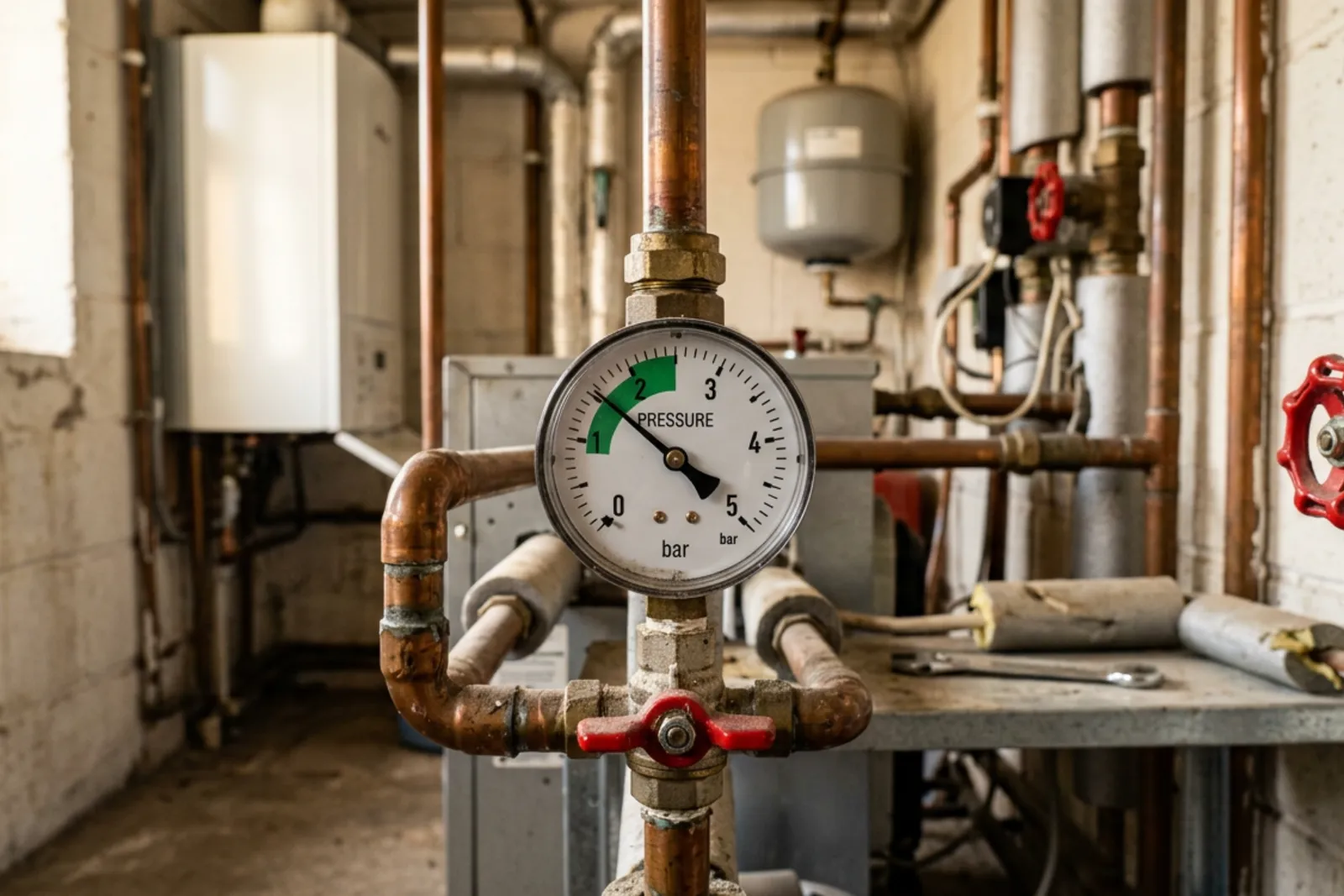
A boiler’s pressure gauge can tell you a lot about the condition of your heating system. A small rise while the heating runs is often normal. A reading that climbs beyond the recommended range, a discharge pipe that keeps dripping, or pressure that needs topping up every week deserves attention.
The difficulty is that different faults can produce similar symptoms. High pressure may involve an expansion vessel, while recurring low pressure may point to a leak. Sometimes the two are connected: pressure rises too far, a safety valve releases water, and the gauge reads low once the system cools.
You do not need to diagnose the fault yourself. What helps is knowing which changes are expected, which observations to record, and when to stop making adjustments and arrange qualified service.
What Is Normal Boiler Pressure?
Many residential boilers with sealed heating systems operate at about 1 to 1.5 bar when cold. When the heating runs, the water expands and the pressure usually rises somewhat.
That cold reading is a useful reference, not a universal setting. The correct pressure depends on the appliance, system design, and building height. Your boiler manual should specify the recommended operating range.
As a general guide:
A cold reading around 1 to 1.5 bar is common in many sealed residential systems.
A reading below 0.5 bar generally warrants attention.
A reading above 2.5 bar generally warrants prompt professional assessment, especially if it keeps rising or water is discharging.
The manufacturer’s guidance takes priority over these general figures. Some systems have different requirements, and open-vented heating systems do not work in the same way as sealed systems.
It also helps to understand what the gauge measures. In a typical sealed hydronic heating system, it shows the pressure in the closed circuit supplying radiators or in-floor heating. It does not necessarily show the pressure at your faucets. A combination boiler may provide both heating and domestic hot water, but those water circuits perform different jobs.
A Normal Pressure Rise Versus a Persistent Fault
The most useful question is often, “What happens over a complete heating cycle?”
A healthy system can show a modest increase as it warms, then return toward its usual cold reading after cooling. The expansion vessel accommodates that change in water volume.
A fault becomes more likely when pressure repeatedly exceeds the appliance’s recommended range, changes sharply, or fails to return to its usual level. The same applies if the system releases water or regularly needs refilling.
For example, imagine a boiler that starts at 1.2 bar when cold, climbs close to the upper limit during heating, then falls unusually low afterward. Adding water may restore the cold reading temporarily. But if that pattern repeats, topping up is not a repair. The system may be losing water through its pressure-relief valve after an excessive pressure rise.
A single reading gives you a snapshot. A pattern gives a technician much more useful information.
Warning Signs That Need Attention
The gauge is above the recommended range
Pressure above 2.5 bar is a reason to arrange prompt assessment, even if the boiler still heats the home. Do not wait for a shutdown or visible leak before taking an out-of-range reading seriously.
The rate of change matters too. A reading that climbs rapidly whenever the heating starts is different from one that remains slightly elevated after an accidental overfill. Both need evaluation, but the likely causes may differ.
A discharge pipe is dripping or releasing water
A pressure-relief valve, often called a PRV, is a safety device that releases water when pressure reaches its opening threshold. In many domestic systems, that threshold is around 3 bar, although specifications vary.
Water from the associated discharge pipe can mean the system pressure is too high. It can also mean the valve is no longer sealing properly. A valve that has opened may continue dripping if debris or damage prevents it from closing fully.
Never cap, plug, or obstruct a discharge pipe. Do not touch the discharge water to test its temperature; it may be hot. If you are unsure which pipe you are seeing, describe its location to the technician rather than assuming it is the PRV outlet.
Pressure keeps falling
A boiler that needs repressurizing every week has an unresolved problem. The cause might be a visible leak, a concealed leak, a faulty valve, or another component issue.
Look for damp patches around accessible radiator valves, staining beneath exposed pipe joints, or water near the boiler. These are observations you can make without dismantling anything. An absence of visible water does not rule out a leak.
Heating performance changes
Pressure faults may coincide with a boiler lockout, an error code, or loss of heating. Those symptoms do not identify the faulty part, but they help establish urgency.
Record any displayed code exactly. Repeatedly resetting the boiler can obscure the pattern and will not correct a leak or failed component.
Why Boiler Pressure Goes Too High or Keeps Dropping
The expansion vessel cannot absorb expansion
Water expands when heated. In a sealed heating system, the expansion vessel provides space for that extra volume.
The vessel usually contains water on one side of a flexible membrane and a pressurized gas cushion on the other. If the gas charge becomes insufficient, the membrane fails, or the vessel has another problem, it may no longer accommodate expansion properly.
Pressure can then rise excessively during heating. If the PRV opens and releases water, the system may be left with low pressure after cooling.
A technician may need to check the vessel’s charge, condition, connection, and suitability for the system. Recharging may be appropriate in some cases; replacement may be necessary in others. This is not a homeowner adjustment.
Water is escaping from the heating circuit
A leak removes water from the sealed circuit and usually causes pressure to fall.
Some leaks are easy to spot, such as a damp radiator connection. Others occur beneath floors, inside walls, or within the appliance. A small leak may leave staining or deposits rather than an obvious puddle.
Leak location affects both the investigation and the repair. An accessible joint may be straightforward to repair, while concealed pipework can require more extensive tracing and access.
The pressure-relief valve is faulty
A PRV can contribute to ongoing pressure loss if it drips when it should be closed. However, replacing the valve without checking why it discharged may leave the original problem unresolved.
This is why the whole pressure pattern matters. A leaking PRV and an expansion vessel problem can exist together.
Too much water is entering the system
An overfilled heating circuit can begin with excessive cold pressure. A filling device that has not closed properly, or another fault allowing water into the circuit, can also cause pressure to rise.
If your boiler has an accessible filling loop, do not keep operating it to chase a target reading. Follow only the user instructions for your specific appliance. If the pressure continues rising or you are unsure about the controls, leave diagnosis to a qualified professional.
What You Can Safely Check
Useful homeowner checks are observational. There is no need to remove the boiler casing, open a valve, or handle sealed-system components.
If you can do so safely:
Read the pressure gauge and note whether the system is cold or heating.
Check the manual for the appliance’s specified pressure range and shutdown instructions.
Look for visible leaks or water damage around accessible pipework, radiators, and the boiler.
Note any error codes, unusual sounds, discharge, and recent topping-up.
Record whether pressure rises during heating, falls after cooling, or changes while the heating is off.
Photographs of the gauge and any visible leak can help explain the problem. Take them from a safe position without reaching into the appliance or approaching hot discharge.
If the manual directs you to turn off the heating, follow that guidance. Do not remove the casing, recharge the expansion vessel, operate the PRV, or work on gas components.
Avoid repeatedly bleeding radiators simply to lower pressure. Although radiator bleeding is a routine task on some systems, using it to manage recurring high pressure can hide the symptom without addressing the cause.
When to Call for Help, and When It Is Urgent
Arrange prompt professional assessment if pressure exceeds 2.5 bar, repeatedly falls below the recommended range, or needs frequent topping up. A PRV that drips or discharges also needs assessment.
Active discharge, a visible leak, or developing water damage makes the situation urgent. Keep clear of hot water and wet electrical equipment. Do not touch the boiler or its electrical controls if doing so would put you in contact with water.
Loss of heat needs prompt attention too, particularly during freezing weather or where occupants depend on reliable warmth for health reasons. If the boiler locks out, follow the manual’s instructions and seek service rather than repeatedly attempting resets.
A gas odor requires a different response
If you smell gas or suspect a gas leak, stop investigating the pressure problem.
Do not operate electrical switches, use flames, or attempt boiler repairs. Leave the affected area and contact the appropriate gas emergency service or utility from a safe location, following local guidance. Do not return until the appropriate authority says it is safe.
A pressure fault does not automatically mean there is a gas leak. But a gas odor takes priority over every other symptom.
What Professional Diagnosis Should Cover
A useful assessment looks beyond the current gauge reading. The technician needs to understand what happens while the system heats, cools, and remains idle.
Depending on the symptoms, the investigation may include checking the expansion vessel, testing the filling arrangement, locating leaks, assessing the PRV, and verifying the pressure indication. The technician may also review whether previous work or system changes affect how the heating circuit operates.
Choose someone qualified for the appliance and the work involved. Boiler casing access, gas work, and sealed-system repairs require appropriate training and credentials. Where gas work is needed, use a properly licensed gas fitter.
Repair costs depend on the failed component, access, leak location, and whether emergency attendance is necessary. Ask what the diagnosis has established and whether the proposed repair addresses the cause of the pressure change.
High pressure alone does not mean you need boiler replacement. Many pressure faults involve repairable components. If replacement is recommended, ask why repair is unsuitable and how the replacement would be sized. A heat-loss calculation helps determine the heating capacity the home needs, while proper boiler commissioning verifies operating settings and system performance.
Stop the Cycle of Repeated Topping Up
Adding water can make a low-pressure warning disappear. That can feel reassuring, especially when the heating starts again. But repeated refilling leaves the underlying fault in place.
Frequent additions of fresh water can also introduce oxygen and minerals and dilute corrosion inhibitor where one is used. Over time, that can create further problems within a hydronic heating system.
The practical rule is simple: know the normal range for your appliance, watch for recurring changes, and treat discharge or frequent pressure loss as a fault rather than routine maintenance. A clear record of the symptoms, followed by qualified diagnosis, is safer and more useful than repeatedly adjusting the gauge back to a familiar number.
Wondering how this applies to your house?
Send us the make, model and the symptom, we will tell you straight.
Get a fixed quote