
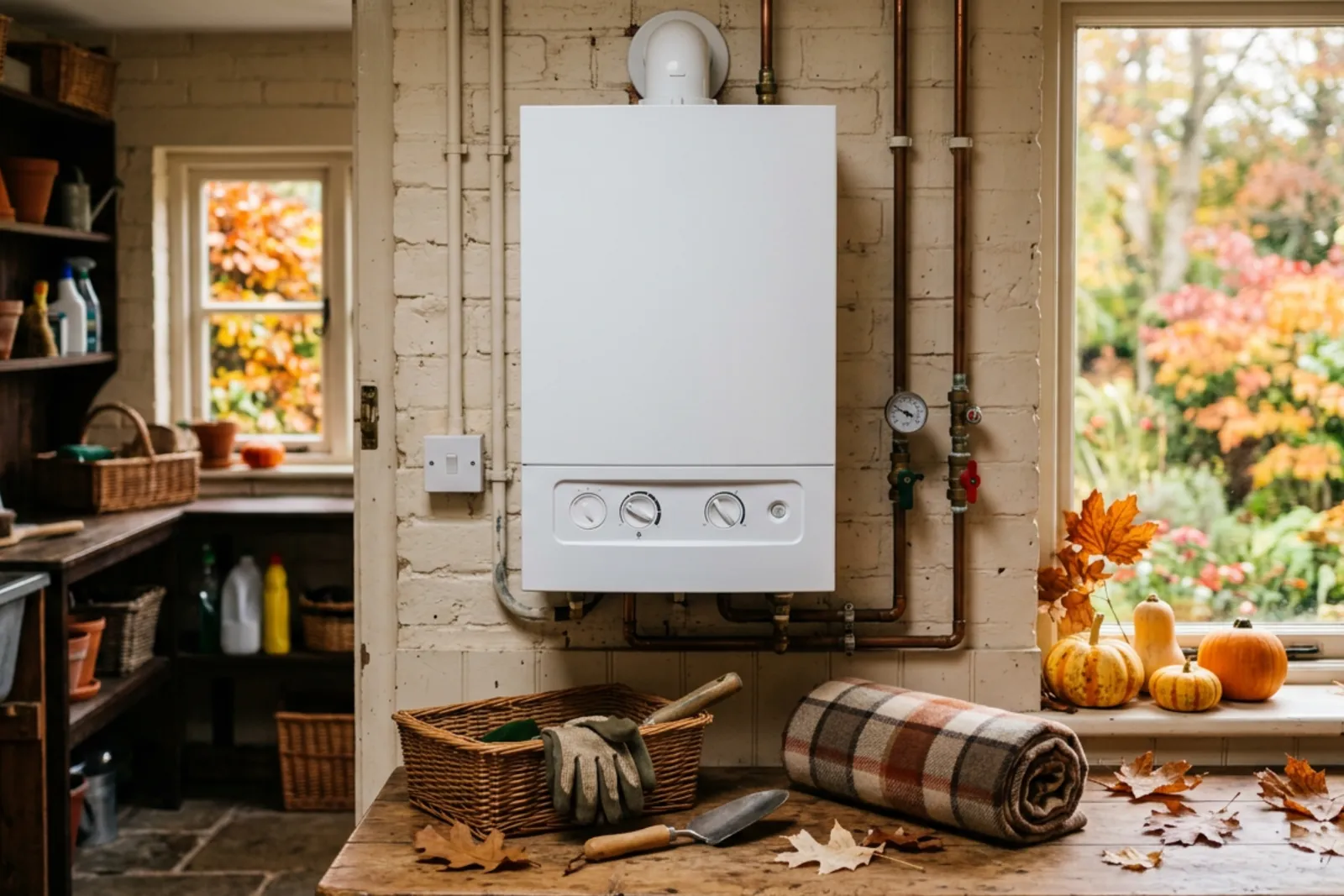
Fall Boiler Inspection: Safe Checks and Warning Signs Before Heating Season
Learn safe fall boiler inspection checks, warning signs, and when to call a professional before heating season. Read the guide to prepare your home for colder weather.
November 8, 2026
The first cold morning is a frustrating time to discover that your boiler will not start. Other problems are quieter: a radiator that stays cool, pressure that slowly drops, or a new rumbling sound whenever the heat comes on.
A fall boiler inspection gives you a chance to notice these changes before sustained heating demand begins. Annual professional service is commonly recommended, although the manufacturer’s maintenance schedule should guide your particular equipment.
Your part is observation, not repair. You can check normal controls, record readings, and look for visible problems without opening the appliance. A qualified professional handles combustion testing, internal components, and safety devices.
Here is how to make that distinction, what to watch for, and when to stop checking and get help.
Why Check Your Boiler Before Cold Weather?
A boiler can appear to work while a problem develops. Mineral deposits may reduce heat transfer. A circulator pump may begin wearing out. Electrical connections, ignition components, and controls can deteriorate without immediately stopping the heat.
Professional maintenance can identify some of these issues before they cause a breakdown. It also provides an opportunity to check combustion, venting, and protective controls, which cannot be assessed simply by confirming that the house feels warm.
Regular maintenance supports safe, efficient operation and may help equipment last longer. It does not guarantee trouble-free heating, but it gives you a better picture of the system’s condition.
Fall is a practical time to arrange service because you can address findings before the boiler runs for longer periods. If heating season has already started, the inspection is still worthwhile.
Know What Kind of System You Have
“Boiler” covers several equipment types. Homes may have conventional gas, high-efficiency condensing, oil-fired, or electric boilers. A combi boiler can provide both space heating and domestic hot water.
The distribution system matters, too. Hydronic heating can supply radiators, baseboard heaters, or in-floor heating, each with different operating characteristics. Radiant floors usually respond more slowly than radiators, so a gradual temperature rise is not automatically a fault.
Some boilers heat domestic water through a separate indirect tank. A tankless water heater is generally a different appliance, even though both may heat water on demand.
These differences affect pressure readings, maintenance requirements, and reasonable expectations. Use the appliance manual rather than a generic checklist whenever the two differ. Never apply a hot-water boiler pressure guideline to a steam system.
A Safe Homeowner Walkthrough
Keep the boiler’s covers in place. Use only normal user controls, and observe equipment from an accessible location. Do not reach behind hot pipes, climb to inspect a vent, or move anything connected to the appliance.
Check the thermostat and heating response
Confirm that the thermostat is in heating mode and set above room temperature. Check its schedule, display, and batteries if applicable.
Then observe whether the boiler responds and heat reaches the intended rooms. Allow time for the system to warm up, especially with in-floor heating.
Notice whether the boiler repeatedly starts and stops without satisfying the thermostat. This behavior, often called short cycling, can have several causes. Thermostat settings, poor circulation, controls, or equipment sizing may be involved.
Some systems intentionally vary output or cycle under light demand. What matters is a persistent problem, a change from normal behavior, or failure to keep rooms comfortable.
Look for uneven heating
Walk through the heated rooms once the system has had time to operate. Does one radiator remain cool while others warm up? Is an entire zone affected?
Cold areas in radiator heating can be associated with trapped air, sludge, restricted flow, or valve problems. The pattern is useful information, but it does not establish the cause.
Avoid bleeding radiators simply because they feel uneven. Bleeding changes system pressure and is not appropriate for every setup. Follow the manufacturer’s user instructions or have a technician assess the system, particularly if you already see pressure loss.
Look for water and staining
Check visible areas around the boiler, accessible piping, valves, and connections. Look for dampness, droplets, corrosion, or mineral deposits that suggest an intermittent leak.
Record where the water appears and whether it happens during operation or afterward. A photograph can help distinguish a recurring problem from an old stain.
Condensing boilers normally produce condensate, which should drain through designated piping. Water pooling beneath the appliance or escaping from a connection still needs attention. Do not assume it is harmless condensation.
Keep clear of water near electrical equipment and avoid touching leaking components. Water and nearby surfaces may be hot.
Read the pressure gauge without adjusting anything
Record the pressure reading and whether the boiler is cold or running. If practical, compare readings under similar conditions on different days.
Many sealed residential hot-water systems have a cold pressure near 1 to 1.5 bar, but this is not a universal operating range. Building height, system design, temperature, and manufacturer specifications affect the correct pressure.
Pressure normally changes as water heats and expands. A reading outside the appliance’s specified range, a large unexplained swing, or repeated pressure loss needs professional assessment.
Do not repeatedly add water to compensate for falling pressure. That can conceal a leak or another fault and introduce fresh minerals and oxygen into the heating circuit.
Listen and record display messages
New banging, rumbling, whistling, or kettling sounds deserve attention. Note whether they occur at startup, during heating, or after the boiler stops.
Photograph any warning lights or error codes if you can do so safely. Record how often they appear and whether heating or hot water stops.
Do not repeatedly reset a boiler that locks out. A lockout is a protective response, and repeated resets can delay diagnosis of an unsafe or damaging condition.
What Common Warning Signs May Mean
Symptoms help a technician narrow the investigation. They rarely identify one failed part with certainty.
No ignition or no heat
A boiler that does not fire may have a problem with ignition, the burner, controls, power, or fuel supply. A heating failure can also occur when the boiler runs but water does not circulate properly.
You can check the thermostat and read the display. Leave fuel-system checks, internal electrical testing, and burner work to an appropriately qualified professional.
Banging or kettling
Kettling describes a rumbling or boiling-like sound that can occur when heat transfer or water flow is restricted. Possible causes include scale on the heat exchanger, trapped air, pump problems, or abnormal operating conditions.
Loud or worsening banging warrants prompt attention. Do not keep running the boiler just to see whether the sound clears.
Falling pressure or recurring leaks
Pressure loss may come from a visible system leak, a hidden leak, a passing pressure-relief valve, or an expansion-tank problem.
An expansion tank accommodates the increase in water volume as the system heats. If it is not working correctly, pressure may rise excessively during heating and fall after water is discharged or the system cools.
Never cap, plug, or obstruct a pressure-relief discharge pipe. Its purpose is to release pressure when necessary.
Short cycling and rooms that stay cold
Repeated brief firing can involve circulation, controls, thermostat placement, or a boiler that is oversized for the current heating demand. Uneven comfort can also involve zone valves, balancing, or distribution problems.
If boiler replacement is being considered, these symptoms are worth discussing before equipment is selected. A heat-loss calculation helps establish the home’s heating needs. Copying the old boiler’s capacity can repeat an existing sizing problem.
When to Leave the House or Call for Prompt Help
Some warning signs require a different response than scheduling routine service.
If you smell gas
Treat a gas odor as a potential leak. Leave the building and follow local gas-emergency guidance. Do not try to locate or repair the source.
Avoid flames, smoking, electrical switches, and using a phone inside the affected area. Call the gas emergency service or emergency responders from outside, at a safe location.
Do not stay inside to shut down the boiler.
If a carbon monoxide alarm sounds
Leave the home immediately and call emergency services or the appropriate local authority from outside. Do not reenter until responders say it is safe.
Carbon monoxide is odorless. The absence of a gas smell does not establish safety. Headache, dizziness, nausea, weakness, or confusion can be signs of exposure and require urgent attention.
Maintain carbon monoxide alarms according to their instructions and local requirements. Alarms do not replace boiler maintenance.
Other signs that need prompt assessment
Visible soot, new discoloration near the appliance, persistent burning odors, repeated lockouts, loud banging, leaks, and abnormal pressure all warrant professional attention.
If the appliance has a pilot flame visible through a manufacturer-provided viewing opening, an unexpected yellow flame is another warning sign. Do not remove a cover to inspect it. Flame appearance alone cannot confirm safe combustion, and some burner designs have different normal characteristics.
Shut the system down only if doing so is safe and consistent with the manufacturer’s instructions. Never adjust gas components, alter venting, or open the appliance to investigate.
What Professional Annual Boiler Service Should Cover
The service procedure depends on the boiler’s design, fuel, condition, and maintenance instructions. A proper visit should go beyond confirming that it starts.
For a fuel-burning boiler, the technician should assess combustion and inspect the burner, heat exchanger, flue, and venting. Cleaning should follow the manufacturer’s requirements. Combustion testing helps evaluate operation in ways that a visual flame check cannot.
The inspection should also address system pressure, the circulator pump, expansion tank, accessible piping, electrical connections, and safety controls. Pressure-relief devices need assessment using appropriate procedures, not casual homeowner testing.
For hydronic heating, the technician may investigate air, poor circulation, zone operation, or uneven radiator temperatures. Bleeding or balancing may be appropriate, but neither is a universal remedy.
After maintenance or repairs, the system should be tested under operating conditions. Ask for an explanation of findings, any unresolved concerns, and recommended follow-up. Gas-related work requires a licensed gas fitter or another professional with the qualifications and authorization required locally.
Prepare Useful Notes Before the Visit
You do not need to diagnose the boiler. A short, accurate record is more useful than a confident guess.
Gather the following without dismantling anything:
The boiler make, model, approximate age, and available service history.
The date, outdoor conditions, thermostat setting, and affected rooms or zones.
Pressure readings, including whether the system was cold or heating.
Error codes, unusual sounds, visible leaks, and when each problem occurs.
Safe photographs of the display, gauge, staining, or leak area.
Mention whether the fault is constant or intermittent. “The upstairs zone stays cold during the first morning heating cycle” gives a technician more to work with than “the boiler is unreliable.”
Keep the Inspection Simple and Safe
A useful fall boiler check does not require tools or an open appliance. Confirm the heating response, look for changes, record what you see, and arrange professional maintenance.
The boundary is straightforward: normal controls and accessible visual observations are homeowner tasks. Internal repairs, combustion testing, gas adjustments, and safety-control work are not.
If something seems wrong, accurate notes and timely help are safer than repeated resets or improvised repairs. The aim is dependable heat, with problems investigated before they become an urgent loss of heating.
Wondering how this applies to your house?
Send us the make, model and the symptom, we will tell you straight.
Get a fixed quote