
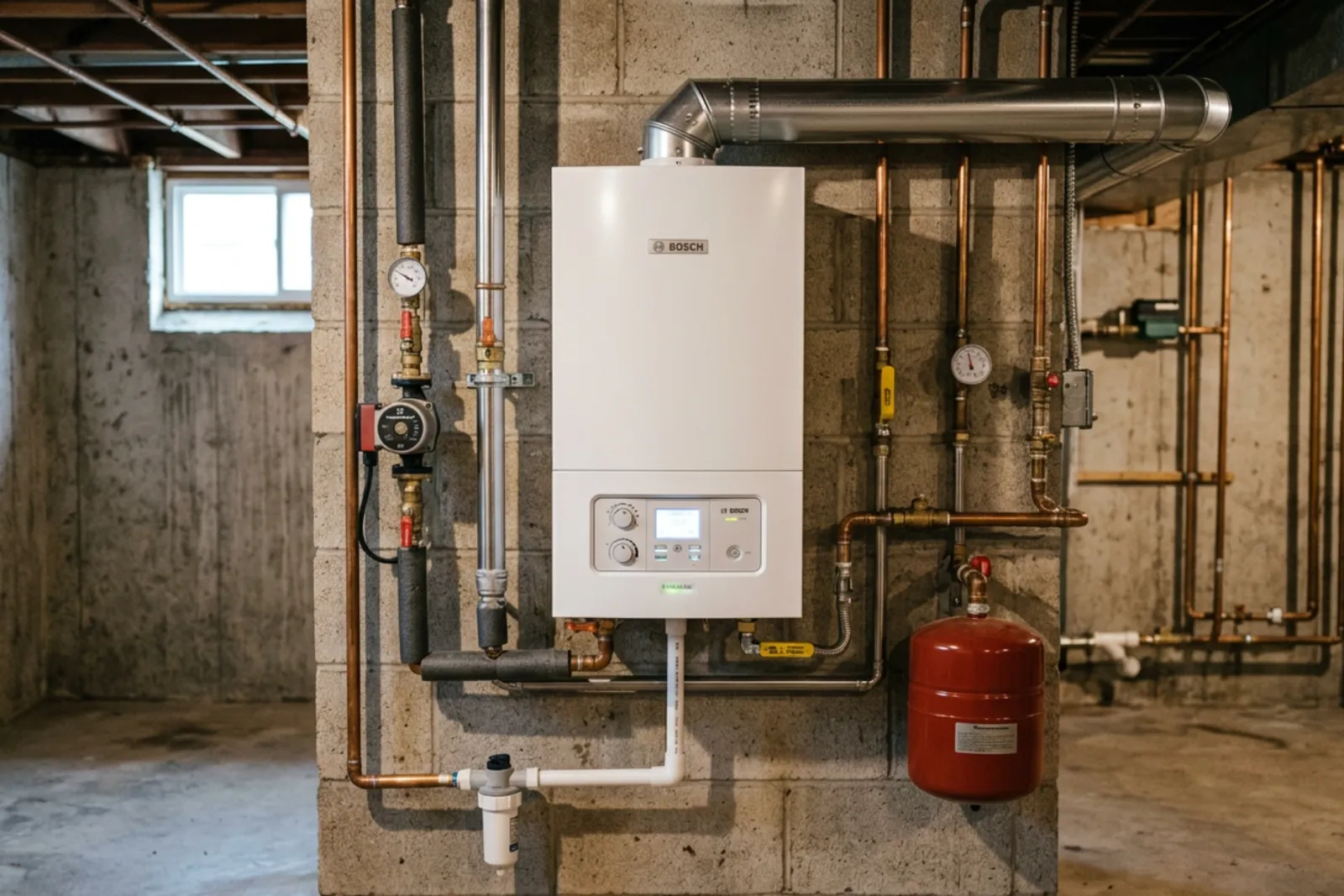
Condensing vs. Non-Condensing Boilers: What Matters in a Retrofit
Compare condensing vs non-condensing boilers for a retrofit. Learn how radiators, venting, drainage, and sizing affect efficiency before choosing a replacement.
October 12, 2026
Replacing a boiler sounds straightforward until you look beyond the appliance. The existing radiators, chimney, drainage, and heating controls all affect which replacement makes sense. A boiler with a higher efficiency rating can use less gas, but its performance depends on how it operates in your home.
That is especially relevant in older homes with radiator heating. A system built around hot water and a metal chimney may need more than a simple equipment swap to get the full benefit of a condensing boiler.
The useful question is: which boiler will work efficiently, safely, and reliably with your heating system, and what changes will it need?
Here is how to compare the options before committing to a boiler replacement.
What Makes a Boiler Condensing?
Both condensing and non-condensing gas boilers burn fuel to heat water. That water circulates through a hydronic heating system, such as radiators, baseboards, or in-floor heating.
Combustion also produces water vapor and other exhaust gases. A non-condensing boiler keeps its exhaust hot enough that the vapor generally stays in gaseous form as it leaves through the vent. The heat carried by that vapor goes outside.
A condensing boiler captures some of that otherwise lost energy. Its heat exchanger cools the exhaust until water vapor turns into liquid. This change releases latent heat, which the boiler transfers to the heating water.
There is a practical consequence: the liquid has to go somewhere. A condensing boiler needs a condensate drain, while a conventional non-condensing boiler normally does not.
For natural gas equipment, condensation generally begins when return water entering the boiler is below approximately 55°C, or 131°F. The exact threshold depends on combustion conditions. Lower return temperatures usually allow more heat recovery.
A condensing boiler can still heat a home when the return water is hotter. It simply loses some or all of its condensing advantage during those periods.
What AFUE Tells You, and What It Does Not
Annual Fuel Utilization Efficiency, or AFUE, estimates how much fuel energy a boiler converts into useful heat over a typical year under standardized testing conditions.
Representative ratings are roughly:
Boiler typeTypical AFUE rangeOlder cast-iron non-condensing boiler65% to 75%Modern non-condensing boiler80% to 84%Entry-level condensing boiler90% to 92%Higher-efficiency condensing boiler95% to 98%
These ranges are useful for comparison, but individual equipment ratings vary. An older boiler’s present condition also affects its actual performance.
At 80% AFUE, about 20% of the fuel energy is not converted into useful heat under the rating method. At 96%, that share is about 4%. This does not mean replacing an 80% boiler with a 96% boiler reduces the gas bill by 16%. The calculation must account for how much fuel each boiler needs to deliver the same heat.
AFUE also does not describe every part of the installed system. It does not fully account for distribution losses, pump electricity, room comfort, or the effects of poorly configured controls.
Think of the rating as a starting point. Return-water temperature, boiler sizing, cycling, and installation quality determine how closely the system approaches that performance in practice.
Existing Radiators Do Not Automatically Rule Out Condensing
Older radiator systems were often designed for supply-water temperatures around 80°C, or 176°F, during cold weather. If the water returning to the boiler stays above the condensing threshold, heat recovery is limited.
But the original design temperature does not tell the whole story.
A home may now have better insulation, tighter windows, or less air leakage than it did when the radiators were installed. The radiators may also have been oversized. Either situation can allow the home to stay comfortable with cooler water.
Even when high temperatures are necessary on the coldest days, they may be unnecessary during milder weather. A boiler could operate without much condensation during a cold snap and condense for a substantial portion of the remaining heating season.
Start With a Heat-Loss Calculation
A heat-loss calculation estimates how much heat the home needs at the local outdoor design temperature. A room-by-room assessment helps determine whether each radiator can meet that demand at lower water temperatures.
This is more useful than replacing an old boiler with another unit of the same capacity. The old appliance may have been oversized from the beginning.
For example, a hypothetical home might have radiators originally selected for high-temperature operation. After insulation improvements, those radiators may supply enough heat at a lower temperature during most weather. Another home with small radiators and significant heat loss may still need hotter water.
Those homes should not receive the same recommendation simply because both have cast-iron radiators.
Controls Can Make Lower Temperatures Practical
Outdoor reset controls adjust the heating-water temperature according to outdoor conditions. When the weather is mild, the boiler sends cooler water through the system. As temperatures fall, it raises the target.
That approach can increase condensing operation without sacrificing comfort, provided the settings match the building and its heating equipment.
In-floor heating commonly operates at lower temperatures than traditional radiator heating, so it is often a good match for condensing equipment. Mixed systems need closer attention. A home with both radiators and floor heating may require separate temperature controls, mixing arrangements, and carefully designed piping.
Venting Can Change the Scope of the Retrofit
A conventional boiler often connects to a chimney or high-temperature metal vent. Its exhaust may leave at approximately 150°C to 230°C, depending on the equipment and operating conditions.
Condensing boilers discharge cooler exhaust. Many use a fan-driven, sealed-combustion arrangement with an outdoor air intake and a separate exhaust pipe, or an approved combined vent arrangement.
The old vent usually cannot be reused unchanged.
Cooler exhaust may not maintain the draft an existing chimney needs. Moisture can also condense inside unsuitable vent materials and cause deterioration. A vent that worked safely with the old boiler is not automatically suitable for the new one.
Possible retrofit routes include a new sidewall termination or an approved vent system routed through an existing chimney shaft. The design must follow the boiler manufacturer’s instructions and applicable local requirements.
Some boilers permit specified PVC, CPVC, or polypropylene systems. Others require different materials. Ordinary plumbing pipe is not automatically acceptable simply because the exhaust is relatively cool.
Termination location matters too. Clearances around windows, doors, air intakes, walkways, and neighboring properties can limit the available options. Snow accumulation and the visible exhaust plume also deserve attention.
If the old boiler shares a chimney with another appliance, such as a water heater, removing it can change how the remaining appliance vents. That remaining connection needs assessment rather than being left untouched.
Condensate Drainage Needs a Real Plan
Condensate is mildly acidic. It must discharge through suitable materials to an approved disposal point, following the equipment instructions and local rules. A neutralizer may be required or appropriate to reduce acidity before discharge.
A nearby floor drain can make the work relatively simple. A boiler in a basement without convenient drainage may need a condensate pump.
The drain arrangement also needs the correct trap, slope, and protection against freezing. Routing a small pipe outdoors may look easy, but a frozen condensate line can shut down the boiler when heat is needed most.
Ask where the condensate will go and whether a pump or neutralizer is included in the installation scope. These details affect cost and ongoing maintenance.
Remote properties and some propane installations can have more difficult disposal conditions. The problem is usually the site’s drainage arrangement rather than propane itself eliminating the need for condensate management.
Sizing and Commissioning Matter as Much as the Label
Oversizing is common in boiler retrofits. A large boiler may heat the home, but it can also start and stop frequently when the demand is low. This short cycling can reduce efficiency and increase component wear.
Many condensing boilers modulate, meaning they adjust their firing rate to suit demand. However, they still have a minimum output. If the smallest active heating zone needs less heat than that minimum, cycling can remain a problem.
Equipment selection should account for the home’s design heat loss, smaller zone loads, and any domestic hot-water requirements.
Boiler commissioning then checks that the installed system works as intended. Depending on the equipment, this includes combustion testing, gas-pressure checks, vent inspection, flow verification, control adjustments, and confirmation of safety operation.
A correctly sized boiler with well-adjusted controls can perform better than a higher-rated unit installed with unsuitable flow or default settings.
Gas work should be completed by appropriately licensed gas fitters, with required permits and inspections. For homeowners on the North Shore or elsewhere in British Columbia, local requirements must be checked for the specific project.
Compare Total Installed Cost and Realistic Savings
A condensing boiler may cost more than a comparable non-condensing model, but the equipment price is only part of the difference.
New venting, drainage, electrical work, piping changes, controls, and chimney alterations can all affect the total. Labor is not necessarily similar when the installation requirements differ.
Compare written scopes that identify what is included. A lower quote may omit a condensate pump, necessary control work, or changes to a shared chimney.
A Simple Fuel-Savings Example
Suppose a home spends $1,500 annually on gas used specifically for space heating, and its existing boiler operates at an assumed 75% seasonal efficiency.
If a replacement achieved 96% seasonal efficiency while delivering the same useful heat, the estimated heating cost would be:
$1,500 × 0.75 ÷ 0.96 = approximately $1,172
That is about $328 in annual savings.
This is an illustration, not a prediction. It assumes unchanged heat demand and fuel pricing, and that the efficiencies describe actual seasonal operation. Fixed utility charges would not fall in proportion to fuel use.
It also compares the new boiler with the old one. When choosing between two replacement options, compare their expected performance against each other. Savings relative to a modern non-condensing replacement will generally be smaller than savings relative to an inefficient older boiler.
Payback Depends on the Incremental Cost
If the condensing option costs $1,000 more after any applicable rebate and saves $300 annually, simple payback is about 3.3 years.
If difficult venting and drainage increase the difference to $3,000, the same savings produce a 10-year payback.
Neither calculation includes financing, maintenance differences, repairs, or future fuel-price changes. Use payback as one decision tool, not a guarantee.
A FortisBC rebate may affect the calculation if an eligible program is available. Check current program status, qualifying equipment, application deadlines, and installation requirements before relying on any rebate amount. Replacement permissions and minimum efficiency requirements also need confirmation under current rules.
When a Non-Condensing Replacement May Still Be Considered
Some buildings have genuine constraints. Heritage restrictions may limit exterior penetrations. A property may lack an acceptable sidewall termination location. A high-temperature heating system may need substantial changes before it can support much condensing operation.
An urgent failure can narrow the practical options, especially when compatible equipment is difficult to obtain. Safety and code compliance still come first.
These circumstances justify a site-specific comparison. They do not automatically make either boiler type the right choice.
Before deciding, ask the installer:
What heat loss and water temperatures were used to select the boiler?
How much condensing operation is realistic with the existing radiators?
What venting and condensate work is included?
Does another appliance depend on the existing chimney?
What commissioning, maintenance, and rebate requirements apply?
Choose the Boiler as Part of the Heating System
A condensing boiler is often an efficient replacement when the home can support low return-water temperatures and suitable venting and drainage. Existing radiators may work well with it, particularly when heat loss is lower than it once was and controls adjust water temperature to demand.
A constrained installation needs a more careful comparison. Rated efficiency alone cannot resolve a difficult chimney, inadequate radiator output, or poor drainage.
The strongest replacement plan starts with the home’s heating needs, checks the existing distribution system, and includes the work needed to make the new boiler operate properly. That is how an efficiency rating becomes actual fuel savings rather than a number on the box.
Wondering how this applies to your house?
Send us the make, model and the symptom, we will tell you straight.
Get a fixed quote