
Combi or System Boiler? How to Choose a Replacement in North Vancouver
Compare combi and system boiler replacement options in North Vancouver, including hot water capacity, space, and installed costs. Learn which setup fits your home.
September 28, 2026
A boiler replacement can look like a simple equipment swap until someone asks what will happen to the hot water tank. Keep it, replace it, or remove it? That decision changes the piping, the gas requirements, the space needed in the mechanical room, and often the final price.
For a North Vancouver home, a useful budget is $5,000 to $16,650 installed, with a typical replacement around $9,750. Those figures are planning estimates, not promises about a particular house. A compact combi boiler in a straightforward installation sits near the lower end. A larger radiator system with several zones, difficult access, and an indirect hot water tank can land near the upper end.
The best starting point is not a boiler model. It is a clear picture of how the household uses hot water and how much heat the building actually needs.
What each boiler configuration does
A combi boiler supplies space heating and domestic hot water from one appliance, usually mounted on a wall. When someone opens a hot water tap, the boiler switches to heating water for that fixture. There is no separate storage tank.
That makes a combi appealing when floor space is tight. It can suit a smaller home with one or two bathrooms, particularly if showers and other hot water fixtures rarely run together. Removing an aging tank also frees up room. The trade-off is that a combi produces hot water as it is used, so its flow capacity has a limit.
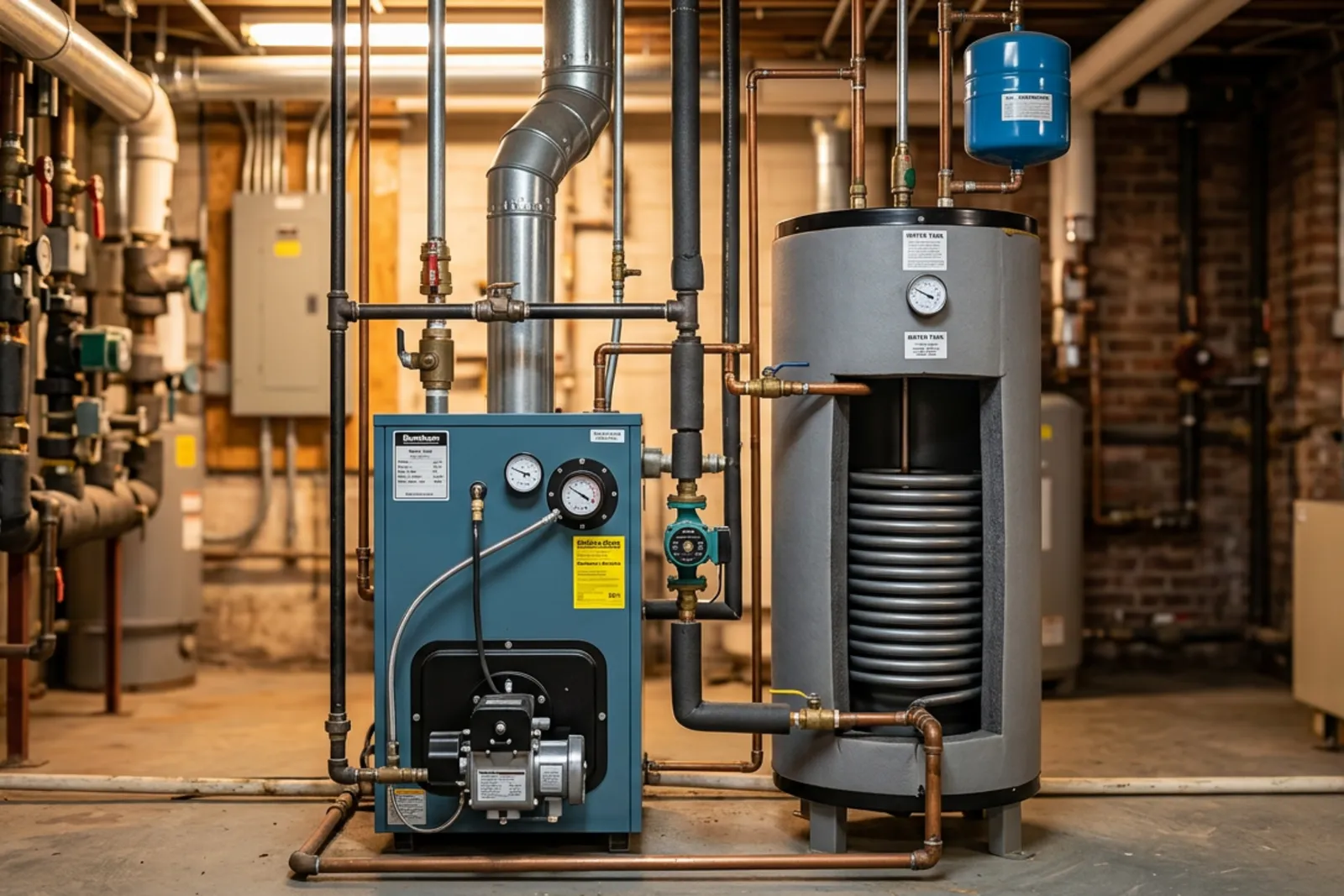
A heat-only boiler or system boiler works with a separate hot water tank. In a common arrangement, the boiler heats an indirect tank through a coil, while also supplying the home’s radiators or in-floor heating loops. Stored hot water can handle short periods of heavy use more comfortably than a combi with limited flow. The tank takes up space and adds piping, controls, and cost.
Here is how the main configurations compare as installed North Vancouver budgeting guides:
ConfigurationTypical rangeApproximate averageGeneral fitEntry-level combi, 84% to 90% efficiency$5,000 to $7,200$6,100Smaller homes with modest peak hot water useMid-range combi, 95%+ efficiency$6,100 to $10,000$8,000Homes seeking space heating and hot water in one appliancePremium combi$7,750 to $15,550$11,650Projects prioritizing particular controls, modulation, or warranty termsHeat-only boiler with a separate tank$7,200 to $14,450$10,550Homes retaining stored domestic hot waterSystem boiler with an indirect tank$11,100 to $16,650$13,300Larger households or substantial simultaneous hot water use
Adding an indirect tank during a replacement commonly adds about $2,500 to $4,000, though the change can cost more if the mechanical room needs extensive reworking. Treat the table as a way to compare designs, not as a substitute for a site-specific quote.
Start with the busiest hot water hour
A household’s peak demand matters more than its bathroom count alone. Two bathrooms might be easy for a combi if their showers are used at different times. One bathroom plus a large tub and frequent laundry could be a different story.
Ask what happens on a normal busy morning. Are two showers running together? Does someone use the kitchen tap while another person showers? If several fixtures need hot water at once, ask the installer to calculate the required flow at the expected temperature rise, not just point to the boiler’s advertised flow rate.
Incoming water temperature matters. A combi must add more heat when incoming water is colder, so the amount of hot water it can deliver at a comfortable temperature can vary by season. Fixture flow rates and the boiler’s output matter too. A model that can supply one shower comfortably may struggle when a second one opens.
There is also a gas-supply question. A combi may need considerably more gas while making domestic hot water than while heating the home. The existing pipe must support the appliance at its required firing rate. Discovering an undersized gas line late in the job can mean opening walls or rerouting pipe.
A tank changes the demand pattern by storing hot water for peak use, but it is not unlimited. A small tank can still run out, and its recovery rate depends on the boiler and tank design. Ask for the tank size and recovery assumptions behind any recommendation.
Size the boiler for the house, not the old nameplate
An older boiler’s rating is a poor shortcut for selecting a replacement. It may have been oversized when installed, and insulation, windows, or room layouts may have changed since then.
A heat-loss calculation estimates how much heat the home needs under local design conditions. The installer should then check whether the existing radiators or in-floor loops can deliver that heat at suitable water temperatures. This is especially relevant in older hydronic homes around Grand Boulevard and Lower Lonsdale, where the radiators may be sound even if the boiler is ready to go.
Oversizing has a cost beyond the equipment price. A boiler with too much output for the load may fire briefly, shut off, and restart repeatedly. That short cycling can reduce comfort and make it harder for the appliance to operate efficiently. A wide modulation range can help a boiler match smaller heating loads, but it does not fix poor sizing or piping.
Mixed systems need extra care. Radiators and in-floor heating may call for different supply temperatures and flow rates. A newer custom home with many zones may need more attention to pumps, valves, and controls than a simple single-loop radiator home. These details rarely show up in a boiler brochure, yet they can drive much of the installation work.
The piping beside the boiler is part of the purchase
It is tempting to compare quotes by appliance model and efficiency rating. I would look just as closely at the drawing or description of the near-boiler piping.
A new modulating boiler needs appropriate water flow, expansion control, air removal, and connections to the existing zones. Depending on the system, the design may use primary-secondary piping, a low-loss header, or another manufacturer-approved arrangement. Circulators must be selected for the system they serve. Isolation valves should make future service possible without draining the entire house.
Existing parts also deserve an honest assessment. A seized zone valve, aging circulator, failing expansion tank, or troublesome in-floor manifold can turn a tidy replacement into a larger repair. Reusing a working component may save money. Reusing one that is nearly finished may simply postpone the bill and require another shutdown.
Request a quote that names the pumps, valves, controls, air separator, expansion equipment, and piping approach. A low price with little detail is hard to compare with a quote that includes those items.
Where the installed price changes
A typical installed price covers the boiler, removal and disposal of the old unit, hydronic and gas connections, required venting, labor, and permits. On a $9,750 replacement, one budgeting breakdown assigns roughly $5,460 to materials, $4,095 to labor, and $195 to permit and disposal costs. That split is illustrative; an indirect tank or difficult removal can change it substantially.
Several conditions deserve attention before a price is finalized.
Venting, condensate, and the old chimney
A condensing boiler commonly needs new intake and exhaust piping and a route for condensate to drain. A neutralizer may be needed under the applicable installation requirements. Replacing an older chimney-vented boiler can therefore involve more than disconnecting one vent and attaching another.
If other appliances still use the chimney, ask what happens to their venting after the boiler is removed. They may need evaluation when the shared venting arrangement changes. The proposed outdoor vent termination should also be shown on the quote.
Access and existing equipment
A cast-iron boiler may have to be dismantled and carried out in sections. Tight stairs, steep grades, or limited vehicle access can add time. Those conditions are worth discussing early in parts of the North Shore such as Lynn Valley and Deep Cove.
Remote valves, radiators, manifolds, and electrical controls are not automatically included in a basic boiler replacement. The quote should say which will be retained, repaired, or replaced.
Permits and inspection
The City and District of North Vancouver have separate municipal processes. Gas work can also involve provincial safety requirements. Because the applicable permits and fees depend on the property and work, ask the contractor to identify the permit authority, what is included in the price, and who will arrange inspection and closeout. A quoted permit allowance is more useful than assuming every house has the same fee.
What a sound replacement process looks like
A good installation starts with a survey. The installer checks heat loss, hot water demand, emitters, zones, controls, gas capacity, access, and venting options. Only then does the final equipment selection make much sense.
Next, the hydronic system is isolated and drained, and the old boiler is disconnected and removed. The new appliance is mounted, followed by the supply and return piping, pumps, valves, expansion equipment, and controls specified in the design. Gas connections are leak-tested. Venting and condensate drainage are installed to suit the new equipment.
The finishing work is less visible but matters. Each loop needs filling and air purging. System pressure and expansion settings need checking, and zones should receive appropriate flow. Trapped air can leave a room cold even when the new boiler fires normally.
Finally comes boiler commissioning: verifying gas pressure at the required operating conditions, checking combustion with instruments, setting controls such as outdoor reset where applicable, and completing required inspection steps. Ask for the commissioning record and combustion readings. Some manufacturers require licensed installation and documented commissioning for warranty coverage.
A straightforward swap may take four to six hours, but complex piping, difficult removal, or multiple zones can extend the work to several days. Gas connections, venting, combustion testing, and certification are jobs for qualified professionals, not a practical homeowner project.
When replacement is worth discussing
Age alone does not condemn a boiler, but a unit past roughly 20 years deserves a closer look if repairs are becoming frequent. Leaks, corrosion, rust staining, unavailable parts, or persistent short cycling can strengthen the case for replacement. So can an original efficiency rating in the 70% range.
Other symptoms need diagnosis before anyone orders a new boiler. Radiators that need frequent bleeding may indicate an air or pressure problem. A zone that stays cold could have a failed valve or circulator rather than a failed boiler. Replacing the appliance without finding the fault risks carrying the same problem into the new system.
A household may also choose replacement to change its hot water arrangement. If reclaiming the tank’s floor space is the goal, assess combi performance before removing it. If several people depend on simultaneous showers, retaining stored hot water may be the calmer choice.
How to compare quotes without guessing
Get proposals for both a combi and a boiler with an indirect tank if either could meet the household’s needs. Provide the same description of fixture use and existing heating problems to each installer. Then ask:
What heat-loss result and peak hot water demand were used to select this equipment?
Which existing pumps, valves, controls, and expansion components will stay?
What near-boiler piping arrangement is included?
Are gas-line changes, venting, condensate work, removal, permits, and disposal included?
Where will the new vent terminate, and what happens to any appliances still using the chimney?
What commissioning records and warranty documents will I receive?
Check current rebate rules before counting an incentive as a project saving. Eligibility can depend on the fuel being replaced and the specific program; a gas-boiler-to-gas-boiler swap should not be assumed to qualify. If the boiler and hot water tank are both aging, price the decisions together. Planning replacement during warmer months can also give you more time to compare designs without an urgent loss of heat.
The right configuration is the one that meets the home’s calculated heating load and its real peak hot water demand, with piping and controls that let the equipment do its job. A combi may be simpler and save space. A system with an indirect tank may make busy mornings easier. Neither is the default answer for every North Vancouver home.
Wondering how this applies to your house?
Send us the make, model and the symptom, we will tell you straight.
Get a fixed quote