
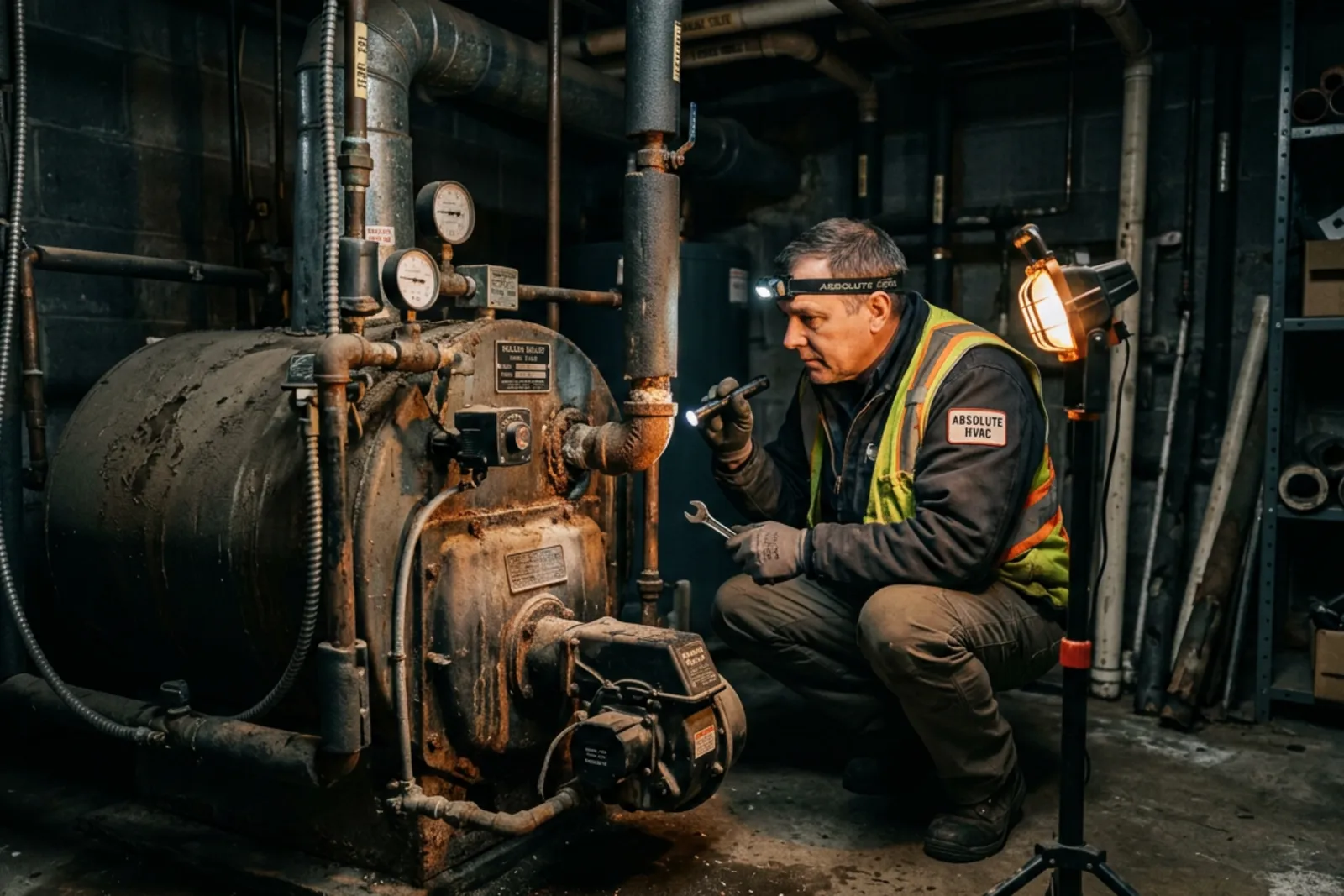
Boiler Repair or Replacement: How North Shore Homeowners Can Make the Right Call
Learn how North Shore homeowners can decide between boiler repair or replacement. Assess safety, costs, efficiency, and reliability today.
September 21, 2026
A boiler breakdown puts homeowners in a difficult spot. The house is cold, hot water may be limited, and the repair estimate can arrive before you have had time to understand what failed. It is tempting to choose the fastest or cheapest option. Sometimes that is the right move. Sometimes it means paying for a major repair on equipment that is already near the end of its working life.
The better question is not simply, “Can this boiler be repaired?” Most boilers can be repaired. The question is whether repairing it is sensible when you consider safety, reliability, fuel use, parts availability, and the cost of another failure next winter.
This guide covers how to evaluate boiler repair versus boiler replacement in North Vancouver, West Vancouver, and other North Shore communities. The same principles apply whether your home has radiator heating, baseboard units, in-floor heating, or a mixed hydronic heating system.
Start With Safety, Not the Repair Estimate
A boiler is a gas-fired combustion appliance in many homes. If something seems unsafe, cost comparisons can wait.
Leave the home and call for emergency help from outside if a carbon monoxide alarm sounds. If you smell gas, avoid operating light switches, appliances, or anything that may create a spark. Get to a safe area, then contact the gas utility or emergency services according to local procedures.
Other warning signs deserve prompt attention from a qualified gas fitter or heating technician:
A yellow or lazy burner flame instead of a steady blue flame
Soot, scorching, or discoloration near the boiler or vent pipe
Burning smells or unusual exhaust odors
Persistent lockouts and combustion-related error codes
Water leaking near electrical components
Pressure that is unusually high or entering the red zone on the gauge
Loud banging, kettling, or rumbling sounds
A damaged flue, disconnected venting, or signs of moisture around vent joints
Many residential hydronic systems operate near 1 to 1.5 bar when cold, though the correct pressure depends on the system design and the height of the building. Do not treat the gauge as a diagnosis by itself. Low pressure can point to a leak, a failed expansion tank, or a pressure-relief issue. High pressure can also signal an expansion tank problem, an overfilled system, or a control fault.
Safety testing should include combustion checks, carbon monoxide testing, venting inspection, and verification that safety controls work as intended. A boiler that runs is not necessarily a boiler that is safe.
Common Boiler Problems and What They May Mean
Some failures are isolated, affordable repairs. Others suggest that multiple parts are aging together or that the underlying hydronic system has problems.
A boiler that will not ignite may have a faulty igniter, flame sensor, gas valve, control board, thermostat signal issue, or venting-related safety shutdown. An electronic error code can help point the technician in the right direction, but it rarely tells the whole story.
Cold radiators do not always mean the boiler has failed. The cause may be trapped air, sludge in old piping, a stuck zone valve, a failed circulator pump, poor balancing, or thermostat settings. In homes with in-floor heating, slow response times are normal, but rooms that never reach the set temperature may indicate a circulation, mixing-valve, control, or design issue.
Banging and kettling noises are worth taking seriously. Scale buildup in the heat exchanger can create localized boiling. Restricted flow, air in the system, pressure problems, and pump failures may produce similar sounds. A noisy boiler does not automatically need replacement, but it needs a proper diagnosis rather than a quick adjustment and guess.
Water leaks also vary widely in severity. A worn valve or pipe fitting may be a straightforward repair. Leakage from the heat exchanger or corrosion within the boiler can change the whole financial calculation.
The Age Rule Is Useful, but It Is Not the Whole Story
Boiler age is one of the first facts to gather. Find the make, model, serial number, fuel type, and approximate installation date. Keep any previous invoices nearby. A service history often reveals whether the current breakdown is unusual or part of a pattern.
As a general guide, a boiler under about 12 years old often makes sense to repair if the heat exchanger is sound and parts are readily available. A repair bill can feel painful, especially during a cold week, but replacing a relatively young boiler after one failed pump or igniter is often unnecessary.
Once a boiler passes roughly 15 years, the decision gets more complicated. Older conventional boilers can remain dependable, particularly if they were maintained well. Still, age increases the chance of corrosion, unavailable parts, control failures, declining efficiency, and repeat service calls.
The heat exchanger matters more than almost any other component. If it is cracked, leaking, badly corroded, or otherwise compromised, replacement is usually the more responsible choice. Heat exchangers are expensive, and replacing one in an old boiler can leave you with a large investment in equipment that still has aging pumps, controls, valves, and venting components.
A Practical Repair Versus Replacement Test
Homeowners often hear a version of the “50 percent rule.” If a repair costs less than half the cost of a suitable boiler replacement, repairing may be reasonable. It is a helpful starting point, not a law.
A $600 expansion tank replacement on an eight-year-old boiler is very different from a $2,200 repair on an 18-year-old boiler with a history of lockouts and poor efficiency. The invoice amount matters, but so does what comes next.
Consider these questions before approving a major repair:
Is the failure isolated, or are several components deteriorating at once?
Is the heat exchanger in good condition?
Are replacement parts available and likely to remain available?
How many service calls has the boiler needed in the past two or three years?
Does the repair restore reliable operation, or merely buy time?
What is the boiler’s actual operating efficiency?
Is the existing boiler correctly sized for the home and heating system?
Would a new system require important upgrades to venting, gas piping, drainage, or controls?
Repairs tend to make sense when the boiler is fairly young, the repair is modest relative to replacement, and the rest of the system is operating well. Replacement deserves serious consideration when a boiler has recurring failures, obsolete controls, expensive parts, combustion issues, or major internal damage.
Look Beyond the Immediate Bill
The cheapest repair is not always the lowest-cost decision over the next five years.
Typical residential boiler repair costs often fall into broad categories. Minor work, such as thermostat replacement, ignition repairs, or pressure-relief valve replacement, may cost roughly $200 to $500. Mid-range repairs, including circulator pumps, expansion tanks, and some control-board work, often land around $500 to $1,000. Major repairs can run $1,000 to $2,500 or more, especially if they involve heat exchangers, complex piping, gas work, or venting corrections.
Actual pricing depends on access, equipment type, emergency timing, labor, replacement parts, and the condition of connected piping. Ask whether the estimate includes diagnosis, parts, labor, warranty coverage, and any necessary commissioning after the repair.
A newer high-efficiency condensing boiler may reduce fuel use by roughly 20 to 30 percent compared with an older, inefficient non-condensing unit. That number is not guaranteed. Savings depend on the old boiler’s condition, local fuel prices, weather, thermostat habits, insulation, and the temperatures required by your radiator heating or in-floor heating system.
Condensing boilers work best when they can return cooler water to the appliance. In-floor heating usually works well at lower water temperatures. Oversized radiators may also perform well with lower-temperature water. Some older baseboard systems need hotter supply water during cold weather, which can reduce condensing efficiency. A competent boiler replacement proposal should address this instead of promising a generic savings figure.
In some cases, local incentives or a FortisBC rebate may affect the numbers. Confirm current eligibility, equipment requirements, and application steps before assuming a rebate is available.
Why Proper Sizing Matters More Than Matching the Old Boiler
A common replacement mistake is installing a new boiler with the same input rating as the old one. That may seem safe, but old boilers were often oversized. A larger boiler is not automatically better.
Oversizing can lead to short cycling, uneven comfort, reduced efficiency, premature wear, and a higher installation cost. An undersized boiler, on the other hand, may struggle during prolonged cold weather or fail to meet domestic hot-water demand in a combination boiler setup.
The right starting point is a heat-loss calculation. It estimates how much heat the house loses under design winter conditions. It considers the home’s size, insulation, windows, air leakage, layout, and local climate. For North Shore homes, mountain weather, rain, wind exposure, and varied housing stock make generic sizing especially unreliable.
A proper design review should also consider:
The condition and capacity of radiators, baseboards, or radiant-floor loops
Domestic hot-water demand, if the boiler provides hot water
Gas-line capacity and electrical requirements
Venting route and combustion-air needs
Condensate drainage for condensing equipment
Pumps, zoning, expansion control, air elimination, and piping layout
Freeze protection for exposed or vulnerable piping
Older homes may also have aging valves, corroded pipes, or poly-B plumbing elsewhere in the property. Those issues do not automatically require a full repiping project, but they should be identified honestly when work will expose related concerns.
What a Good Diagnosis Should Include
A boiler diagnosis should explain the cause of the failure, not merely name the failed part.
For example, replacing a circulator pump may restore heat. But why did the pump fail? Was the system full of sludge? Was there air in the piping? Was the pump improperly sized? Has it been running against a closed valve or faulty zone control? Without those answers, the replacement part may become a temporary patch.
A thorough inspection may include the burner assembly, heat exchanger, flue, thermostat, gas valve, expansion tank, pressure-relief valve, circulator pump, safety controls, and system pressure. In a hydronic heating system, the technician should also assess distribution performance, radiators or floor circuits, zone valves, air elimination, and controls.
Before approving work, request a written estimate that separates immediate repairs from recommended upgrades. It should be clear what is urgent, what is optional, and what may become a future concern.
Permits, Gas Work, and Boiler Commissioning
Boiler replacement is more than swapping one metal box for another. Gas-fired equipment may require permits, inspections, and licensed gas-fitting work depending on the scope and local rules.
Homeowners in North Vancouver and West Vancouver should ask who will handle permits, coordinate required inspections, correct deficiencies, and provide completion documentation. A project involving new venting, gas-line changes, electrical work, condensate drainage, or major hydronic alterations may have several compliance requirements.
The job should end with boiler commissioning. This means testing the system under operating conditions, checking combustion, confirming pressure and temperature behavior, verifying thermostat response, and testing safety shutdowns. It also means confirming that the relief valve, expansion control, venting, and condensate disposal work correctly.
Commissioning is where a replacement becomes a functioning heating system. Skipping it is a bad bargain.
Maintenance Can Prevent Some Breakdowns
Annual boiler service is a sensible habit, particularly before the heating season. September or October is often a practical time to schedule it, before the first cold-weather rush.
A maintenance visit may involve cleaning and inspecting the heat exchanger, checking the burner, verifying combustion, testing safety controls, inspecting the flue, checking pressure, and examining pumps, valves, electrical connections, and the expansion tank. Radiators may need bleeding if air has collected in the system.
Maintenance will not solve an incorrectly sized boiler, failing heat exchanger, unsafe venting arrangement, or worn-out distribution system. It can, however, catch developing trouble early and reduce the odds of losing heat during the wettest part of a North Shore winter.
The Bottom Line
Repair is often the right answer for a newer boiler with an isolated failure. Replacement becomes more compelling when the boiler is older, inefficient, unsafe, hard to source parts for, or expensive to keep alive.
Do not decide based on a single number. Compare the repair cost with the installed cost of a correctly sized replacement, expected fuel use, likely remaining life, and the condition of your hydronic heating system as a whole.
Ask for the root cause, an itemized written estimate, safety-test results, warranty details, permit responsibilities, and a clear explanation of what the work will accomplish. A calm, well-documented decision is far better than repeatedly paying for emergency plumbing calls when winter is already underway.
Wondering how this applies to your house?
Send us the make, model and the symptom, we will tell you straight.
Get a fixed quote